Showing posts with label Reading. Show all posts

Friday, May 23, 2014

A Love Letter to Book and Movie Blog Reviewers


Dear book and movie review bloggers,


As previously mentioned, I hate book reviews. But I love books. And movies. I find myself searching out movie reviews after watching each random film Netflix or Amazon Prime or my parents' borrowed Comcast Xfinity sucks me into, an observer of conversations that took place long ago.  Some people seem to feel like there's a glut of opinions online, like Rotten Tomatoes' offering of "regular folks" opinions via blog is an unnecessary addition to the professional reviews which precede them. But. If you're watching a random movie from fifteen years ago, the regular media has dumped those links that promise reviews. It's nothing but 404 messages ad infinitum.  

Bloggers aren't constrained by the concerns of the regular media. Their reviews shine brightly years and years after they first appeared. So, by extension, I would like to extend my hand to book reviewers. Although not as subject to turnover as film, the splashing out of opinion about books is a gift to one who wants to listen to a conversation about a book she just finished at 2 a.m. 


What did I do before all this? As a child of the '90s, this constant access to information is something that has bricked over the past. I swim easily in the sea, forgetting how I used to do things. So what was different? I saw more movies with other people. Watching VHS or DVD releases was a thing. It's still a thing, and a much more accessible one, with Redboxes outside every WalMart. 

Sunday, December 23, 2012

Answering Questions from the Future #1


On the first day of 2012, I started a series of posts that asked questions of the future. Now that the year is almost over, I'm sharing the answers! Though some questions remain unanswered, others were as predicted. A few were a complete surprise. In the final tally, I think my almost 2013 self has far fewer answers than my past self wanted. But the questions are still a useful yearbook of bookish and cultural events of 2012.


Saturday, August 25, 2012

(Almost) Back From Summer Break

(Source)

I've been on vacation from the blog for much of the summer. Like returning to school, I'm both dreading and excited about resuming my usual posting routine. But come Labor Day, I'll be back in my seat in Blogland.

I couldn't resist popping in to talk about NPR's Top 100 List of YA Books. Argument over the value of this list has been heated, and several have eloquently discussed it. I won't rehash the discussion here, but it's worth checking out

The most interesting thing about the list is how off some of the entries are. They're simply not YA. There are a number that are borderline: The Hobbit; Fahrenheit 451; To Kill A Mockingbird. I don't think they're YA, but an argument could be made about their audience. But the books below are unarguably children's books. And in a survey of over 2,000 people, a fair number voted for these books. Someone probably could approximate the statistics, but that someone is not me. Bottom line--people do not know what YA is. But don't ask me to define it. Like obscenity, I know it when I see it!

Without further ado, my top 10, next to the spot the book or series was given on the list:

1/100 The Betsy Tacy series

2/33 The Call Of The Wild

3/14 The Anne of Green Gable series

4/30 Tuck Everlasting

5/41 Dune 

6/51 Treasure Island 

7/44  The Dark Is Rising series

8/18  Lord Of The Flies

9/3 To Kill A Mockingbird

10/7 The Lord Of The Rings

There you have it, folks. The above are by and large awesome books, but they're not YA. Even worse, NPR actually made an attempt to weed out books meant for younger readers. If this sloppiness bugs you, consider the following: for all anyone knows, The Hungry Caterpillar and Good Night Moon could be in the mix, below the one hundred mark. Oy.

Tuesday, June 19, 2012

Book Review: The Unquiet

As I read, I kept waiting for The Unquiet to improve. It has an interesting premise and an engaging narrator. But issues with plot, characterization and plausibility torpedo the novel. The Unquiet’s central theme of the ghost seeking vengeance is very common in both YA and adult literature. It’s common because we as readers enjoy experiencing it over and over again. But it's employed predictably and without sufficient logic, the ubiquity of the trope makes the book that much more disappointing.

Rinn, who suffers from bipolar disorder, and her mother move back to her mother’s hometown in small town Ohio.  They are dealing with the destruction that her illness has wrought in the lives of her and her family. Almost immediately, Rinn is embroiled in the mystery of Anneliese, a ghost who supposedly haunts a “tunnel” like hallway that connects a half-built pool to the rest of the high school school. There are some areas where the novel succeeds. The Unquiet is an interesting exploration of a teen struggling with bipolar disorder,  yet at times the descriptions of her manic episodes feel too generic. The depiction of Rinn’s relationships with her family members is the greatest strength of the novel. 

One of the main problems with The Unquiet is that underdeveloped characterization prevents the reader from caring about what the evil ghost does. We don’t develop enough of a connection to the new friends that Rinn’s made in Ohio to really care when the ghost starts to punish them. Similarly, the “instalove” romance that erupts overnight between Rinn and Nate, the boy across the street, doesn’t feel like it’s founded on anything more than a running gag about Rinn being a city girl and Nate being a country boy. However, Rinn has moved from L.A. to a small town in Ohio. Both Rinn and Nate act as though they’re in an isolated spot in Montana or Idaho. They’re not even in Iowa! Ohio just doesn’t fit the bill as the setting for a truly country bumpkin town. Minus the plausibility of the subject of the constant teasing between the two, the relationship feels completely random.

Garsee states in an author’s note at the end of the novel that her inspiration came from a real life “tunnel” at her school that was believed to be haunted. Garsee’s genuine attachment to this element of the novel is clear, but the underdeveloped plot feels like window dressing designed to enable the author to write about the tunnel. The final revelations of the ghost’s motivation in harming the teenagers of River Hills High School and Rinn’s ability to banish the ghost aren’t very logical. Without giving away too much of the plot, I was left feeling that Rinn beat the ghost because she was the main character, and that’s who's supposed to save the day. Needless to say, that’s not a great ending.

It's easy to find examples of recent, better written YA novels that I would direct fans of the ghost seeking vengeance theme to first. Anna Dressed in Blood is a much more satisfying read. Laura Whitcomb’s A Certain Slant of Light, while a totally different take on teenage ghosts, is another great book. But those who can't read enough books in this particular vein will still find some enjoyment in this book, as the appeal of the narrator helps smooth over the problematic spots in the book until the inadequate ending . For everyone else, I'd classify The Unquiet as a bench warmer, an adequate back-up for when you must read something but don’t have anything better at hand.

Sunday, June 17, 2012

Bookish Public Service Announcement: Don't Reread

Danger! Danger! On their Books Blog, the Guardian recently asked "Which children's books should you avoid rereading as an adult?"

All of them! Don't do it! Rereading is like the popular conception of time travel: just being in the past will inevitably change things in unexpected ways. It's not that an adult reader can't get a lot out of a book that was a favorite in childhood. I think preserving those first memories is much more important than revisiting a book. As a child, you haven't accumulated hundreds of reading experiences, so any impression is stronger. Books take up emotional and mental space that isn't already cluttered.

When you layer the adult reading experience over the childhood one, inevitably the childhood one is retroactively altered. The first memory is harder to access, because you have to fight through the film of the most current read. The poignancy of the emotional response evoked by the book will never again be so sharp.

Here's my top five list of books I will never open again:

A Wrinkle in Time
Everything about this book was special. Meg's strength, her interesting little brother (I wasn't big on the idea that little brothers couldn't be interesting when I was a child) and the terrifying alternate universe they journey to were different from anything I'd ever read. I can't remember the names of people I met two hours ago, but I can remember almost every detail of this series.

Bridge to Terabithia
This book is special because it opened my eyes to issues of class for the first time. It's also special because it was the first book in which I saw my own tendency to create pretend kingdoms reflected back at me. Finally, the death was so unexpected and painful. I couldn't ever feel that punched-in-the-gut feeling again if I reread it. For some reason, I want to hold on to that.

Tuck Everlasting
I hated the fact that Winnie didn't choose immortality. I hated it so much I almost hated the book. But it forced me to confront the idea of mortality. Maybe that's not a memory one should want to hang on to, but it's a big part of who I am. I wouldn't want to change that.

Jane Eyre
Okay, this book is different because I've actually reread it multiple times. I still hold on to some of the feelings evoked by my first read. But I've lost the fear and loneliness evoked by the beginning, and the awe at the unique character whose brain I was inside. It's such a good book that I don't know how anyone could resist the temptation to reread. But I wish I did.

The Wolves of Willoughby Chase
My first experience of a Gothic thriller kicked off a lifelong obsession. The child heroines who beat the evil adults were pretty awesome too. I made the mistake of choosing this to read aloud to my resident Young Reader. I only got through about a paragraph, because the dense prose wasn't engaging to my listener. Honestly, I wasn't that impressed either. My surprise about not being swept away again is what I associate with the book now.

Of course, because I am perverse, all of the above books carry bittersweet memories strongly involving either death, sadness or fear. No happy frolicking adventures here! I think I'd extend this public service advice announcement against rereading to practically everything important of childhood that's been left left behind: schools, houses, friends, toys and foods. If you try to go back, you only experience a pale echo in the present.

Monday, May 21, 2012

Book Review: Burn Mark

Title: Burn Mark
Author: Laura Powell
Publisher: Bloomsbury Children's Books
Pub. Date: June 19, 2012
ISBN: 9781599908434

If I wrote reviews in the form of Monopoly cards, Burn Mark would get "Advance to Go: Collect $200." It's that awesome. I could stop here, really. You could click away now to pre-order a copy and start counting down the days until June 19. But then I wouldn't get to write about Burn Mark, and I'm bubbling over with things I want to share about this novel.

First, the publisher's summary:
"In a modern world-where witches are hunted down and burned at the stake-two live interact. Glory is from a family of witches, and is desperate to develop the 'Fae' and become a witch herself. Lucas is the son of the Chief Prosecutor for the Inquisition and his privileged life is very different from the witches he is being trained to prosecute. And then one day, both Glory and Lucas develop the Fae. In one fell stroke, their lives are inextricably bound together, whether they like it or not."

In this alternate reality, the classicism of English society is alive and well. Witches are the impure underclass, and non-Fae families such as Lucas Stearne's rule the country. The novel initially focuses on Lucas' world of privilege, giving enough context to measure just how much Lucas loses by becoming Fae. Our immersion in Lucas' life heightens the shock of entering Glory Wilde's world. As part of a family coven that desperately clings to memories of its long gone heyday of power, Glory lives in the Fae area of London, surrounded by poverty and sexism, with few options for her future.

After several twists and turns, Glory and Lucas reluctantly collaborate in a mission to stop a new anti-Fae uprising. Thankfully, there is no "instalove" in this novel. Their friendship is slow to develop, and seems to have the potential to be something more. But their allegiances to their very different worlds run deep. Glory and Lucas are too busy and conflicted to get sidetracked into the obligatory romance. While I love YA romantic relationships, and even the controversial love triangle, it was refreshing to read a novel in which the main characters can interact without falling in love.

Burn Mark is reminiscent of Holly Black's Curseworkers series. Both are set in a modern alternate reality in which supernatural powers and their possessors are controversial, in which gangs and the government dual for supremacy in a battle where each side has equal faults and virtues. But Powell delves more deeply and satisfyingly into the structure of the society Lucas and Glory live in, thoroughly examining both the witch gangs and the government entities designed to suppress the Fae. In the end, both Lucas and Glory realize their worlds are much more similar than they are different. But this realization does not simplify anything.

Lucas and Glory come to terms with being witches, but their futures are complicated and will be difficult to navigate. While I don't know if Burn Mark is the beginning of a series, it stands alone beautifully as the story of the beginning of Lucas and Glory's passages to adulthood. However, I can't imagine it's not the beginning of a series, as Powell has set in motion so many questions and possibilities in a fascinating world that the reader wants to explore further.

As an added bonus to the well rendered universe and compelling plot of Burn Mark, Powell's prose is gorgeous. The character development is masterful as well. Even the depiction of a minor character such as Glory's dad deepens the reader's understanding of the life of the fae through a handful of short but poignant scenes.

I stopped reading early one night because I wanted to prolong the experience another day, which in my rubric is an even higher mark than finishing the book in one sitting. But whether you devour it all in one day or at your leisure, move Burn Mark to the top of your summer to-be-read pile.

Thursday, May 17, 2012

Feature and Follow Friday #20


Feature & Follow Friday is a weekly social blog hop between book bloggers. There are two regular hosts: Parajunkee and Alison of Alison Can Read, and two special guest hosts every week. If you want to join in, click on either of their blogs to get the details. The FF question of the day is: 


Q: Summer Break is upon us! What would be the perfect vacation spot for you to catch up on your reading & relax?

Since this is a fantasy hypothetical, I feel like I should pick someplace exotic that I've never been. But the place that I'd most like to read a book is Nantucket, an island off of Cape Cod in Massachusetts where I was fortunate enough to live for several years.


Nantucket is special for dozens of reasons, but it's uniquely suited for summer beach reading because you can frequently find an uncrowded stretch of sand to make your own. 

You're not part of a hive of humanity crammed onto the beach, so close to the people around you that you're forced to listen to their radios and chit-chat, smelling their sunscreen and snacks. On a good summer day at the right spot on Nantucket, the nearest people are far enough away to be little blobs moving back and forth between the ocean and their umbrella. 

In every other season, you can sit on the beach for hours reading and never see another soul. There's also the gorgeous library and cool bookstore(s), but the biggest attraction for me is privacy. Between the bluff and the ocean only your book exists, until the sun sets.

Bookish Marry, Fuck, Kill: V.C. Andrews

V.C. Andrews
The second round of Bookish Marry, Fuck, Kill belongs to V.C. Andrews.  The first smut I ever read was handed to me by a friend on the bus in middle school.  Not to blame this now-forgotten friend; I would have discovered Andrews on my own eventually. But the sharing of these scandalous books was a rite of passage. Before Andrews, reading was something good for you. But our parents wouldn't have approved of us reading V.C. Andrews, even if they didn't realize it. Flowers in the Attic felt like my tween version of The Anarchist's Cookbook. In hindsight, I realize that illustrates just how sheltered I was.
(Source)

The Rules:
Marry means this will be a book you will own (and presumably read) for the rest of your life. Fuck means you get to read it once, in a literary one night stand, and never again. You're attracted to the book, but you don't want to wake up next to it every morning for the rest of your life. Kill means you eradicate the book from the world. You may even be reaching back in time and strangling the book before it was ever written.
(Source)

The Candidates:
Flowers in the Attic
My Sweet Audrina
Dark Angel

My Choices:
Marry: I'm getting hitched to the least of these three evils, Dark Angel, which is part of the Casteel series. Most of what I remember about this book is the lengthy descriptions of the main character's new school wardrobe. There may well be a high creep factor that I'm forgetting, but in this literary marriage, I'm going to cling to that amnesia.
(Source)

Fuck: I really don't even like thinking about this category in the context of V.C. Andrews' books. But I'm going to hold my nose and pick Flowers in the Attic. It was the first Andrews book I ever read. I wish I'd stopped there, but the lure of the forbidden led me to read what felt like dozens. Flowers in the Attic falls near the middle of the Andrews Wrong-O-Meter. The children imprisoned in the attic are victims, and their decisions are easier to understand in this book than in any of those that follow in the Dollanganger series. And by easier to understand, I mean less gruesome and illegal.

Kill: My Sweet Audrina. God, I rue the day I picked up this book. I can count on one hand the books I wish I'd never read, and this tops the list. It's an extremely creepy take on the sexual assault of a child. You thought nothing could be more I-have-to-take-a-shower inducing than the Dollanganger series? Think again, friends. I believe book burning is far worse than flag burning, or any other kind of object burning, but I'd be tempted to throw this one on the censorship pyre.

Has your sordid fascination with Andrews been reawakened? Check out The Complete Annotated V.C. Andrews Blog-O-Rama, a site devoted to the rereading and analysis of Andrews' body of work.

Wednesday, May 16, 2012

YA Highway Road: Trip Wednesday #18


"Road  Trip  Wednesday is a ‘Blog Carnival,’ where YA Highway's contributors  post a  weekly writing- or reading-related question that begs to be  answered.  In the comments, you can hop from destination to destination  and get  everybody's unique take on the topic." 

Today's question on the  YA  Highway Road Trip is:

What book brings back memories?

(Source)
The better question for me would be what book doesn't bring back a memory? Just like songs and smells, I associate books with the time and place in which I experienced them. Those connections accumulate with favorite books, as I form new associations every time I reread them. 

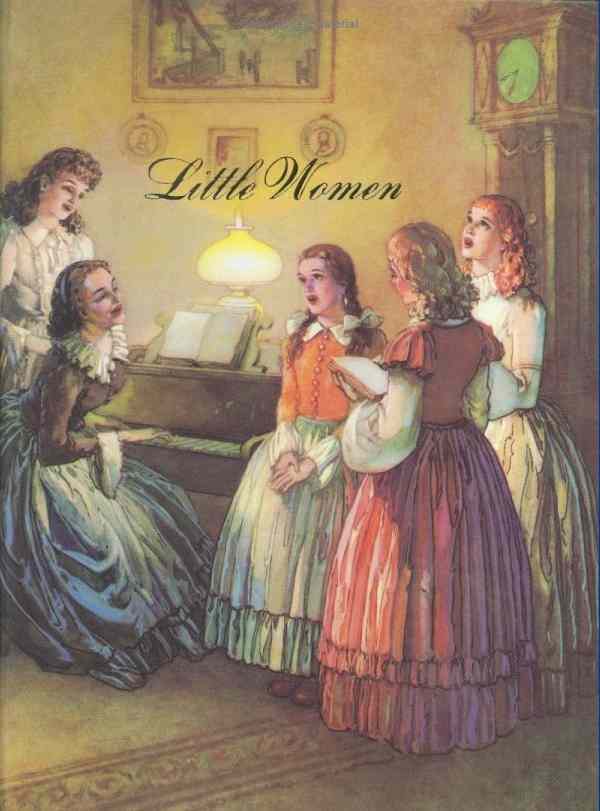
I suppose one of my favorite book memories is a little strange, because it's sad. I was about 8 or 9, and reading Little Women in our finished basement. Incidentally, it's starting to feel like I talk about Little Women every other post. Note to self: blog moratorium on Alcott.

Back to the basement. My zebra finches lived down there, and so did my plastic pony on a spring frame that almost seemed real when you rode it.  When I came to the part where Beth dies, I sobbed and sobbed. Crying over art was not a new experience, because I was a pretty weird little kid. I cried so hard at the end of E.T. that we were the last ones to leave the theater. My mom had to pry me from my seat. I also used to cry as a toddler when my parents told me sad nursery rhymes, like "Hush Little Baby." (The theme is deeply depressing, people!)

But I hadn't read a book that broke my heart until Little Women. A little bit later, Black Beauty would wreck me, but Little Women was the first book that hurt me. It was so heart-wrenching in part because Beth's death is drawn out for maximum effect. But she's also the epitome of female virtue, so it was like if Beth can die as a result of doing a good deed, the rest of us are screwed! I resolved to never do a good deed so that I would live forever. Okay, not really. But I'll never forget wiping my eyes on my sleeve, looking up from the book and feeling like the world had become a little more lonely.

Tuesday, May 15, 2012

Trash or Treasure: The Collector's Guide to Dollhouses and Dollhouse Miniatures

Confession time: I've been obsessed with dollhouses since I was a kid. It's the kind of interest you're supposed to outgrow, like candy necklaces or flicking your brother on the arm during car rides. But for a few adults, the allure of a miniaturized world persists. Marian Maeve O'Brien is one of my tribe.

I found the The Collector's Guide on the permanent sale shelves of a local library. It's the kind of book I would have looked at as a child. It has a certain familiarity, but I can't say whether that's because there are lots of similar books, or because I've seen this one before. What I would have loved as a child are the pictures. Though they're mostly black and white and not very sharp, they're of dollhouses! I'd devour them even if they were as bad as the pictures in Real Boys and Girls Go Birding.

As an adult, I actually read the book. The harrowing anecdotes about the author's personal dollhouses made me glad I bypassed the text as a kid. O'Brien says of her childhood dollhouse,"On the day I moved into a new house as a bride, I came home and found it in flames in the driveway." 

Her next dollhouse, a copy of her home complete with electricity and running water (my inner child is squealing with delight and envy) was destroyed by an angry child brought to an adults only party.

I sympathize with O'Brien's tales of dollhouse tragedy. My own beloved dollhouse was taken to the dump after 20 years of abuse by eager little fingers, but it was a dump where a shack was reserved for items to be given away. I fantasize that some child is currently playing with the miniature replica of my childhood home. At left is some of the flotsam and jetsam from my dollhouse that's survived.

Title: The Collector's Guide to Dollhouses and Dollhouse Miniatures
Author: Marian Maeve O'Brien
Date of Publication: 1974
Publisher: Hawthorn Books
                                                                                                                    ISBN: 0801514045
Pluses:
+ The book is extremely thorough in its coverage of all the various aspects of dollhouses and their contents. The dollhouses of various ladies are described in exhaustive detail.
+ There are a number of decent photographs.
+ The author offers suggestions for how the reader can make or acquire items similar to those described.

Minuses:
- The narrative is a bit dry. When you can't tell how the author feels about her husband lighting her dollhouse on fire, it's a pretty good indication that the book is lacking in verve and enthusiasm.

Final Verdict:
In a decision which I'm sure will surprise no one, I rate this book as Treasure. I'd probably rate any dollhouse book Treasure unless it was a expose on the dangers of the obsession. Like the other books featured thus far in Trash or Treasure, A Collector's Guide is widely available. Until next time, happy Trash or Treasure hunting!

Monday, May 14, 2012

Book Review: Drowned


Title: Drowned
Author: Therese Bowman
Translator: Marlaine Delargy
Publisher: Other Press
Pub. Date: May 22, 2012
ISBN: 9781590515242

Drowned is surprising, a quality that is rare in the books I’ve encountered recently. The mystery isn’t simply unpredictable in that it zigs where you anticipate it would zag; it is also restrained in places where most books would go all out.

Above all things, Drowned is subtle. It demands a careful reader who will not skim over a line or two in an eagerness to discover the twists of the increasingly tense plot. Yet it begins so slowly and simply that the reader doesn’t discover its demands until far along in the novel, a process which mirrors the predicament of Marina, the protagonist.

Marina escapes Stockholm and the university coursework she has failed to complete to spend a few weeks with her sister Stella in the country home of Stella’s boyfriend Gabriel. The depiction of the rural environment is one of the great strengths of the novel. The preoccupation with sensory detail doesn’t just immerse the reader in rural Sweden. Bowman figuratively utilizes the elements of nature in a way that is obvious yet not heavy-handed. 

Stylistically, run-on sentences are so pervasive throughout the novel that one can only conclude that they are a deliberate choice. While at first distracting, these lines work overall in a way I wouldn’t have thought possible by furthering the blurred, dream-like atmosphere of the novel. The sudden, furtive sexual encounters that develop between Marina and Gabriel have an air of unreality. As Marina returns to Stockholm, the relationship seems to end without consequences.

Yet in the second half of the novel, fall has set in, and the haze that summer cast over the characters dissipates. Everything that was established in part one is turned on its head, including Marina’s obsession with Gabriel. Bowman’s brevity and restraint pays off in a wholly unexpected ending. Drowned is a novel that will linger in your mind and leave you eager to turn back to the beginning when you have read the final page.


Disclosure: I received a copy of this book for review purposes from netgalley.com.

Monday, May 7, 2012

Graphic Novel Review: Baby's in Black


Title: Baby’s in Black
Author: Written and illustrated by Arne Bellstorf
Publisher: First Second
Pub. Date: May 08, 2012
ISBN: 9781596437715

It’s been said that true test of your character is how you answer the following question: Stones or Beatles? I have to confess that I choose the Rolling Stones, which excludes me from the target audience for Baby's in Black. I like the Beatles, but I don’t worship them (with the exception of Rubber Soul, which is definitely in my top 5 albums). So as an amateur Beatles fan, I was unfamiliar with Stuart Sutcliffe, the fifth Beatle.

Baby's in Black is a primer on Sutfcliffe and the early years of the band.  It charts the course of Sutcliffe’s relationship with Astrid, a German artist, which coincides with his gradual exodus from the band and his development of a mysterious illness.  As Sutcliffe and Astrid’s relationship progresses, Sutcliffe grows as a visual artist. He leaves the band to pursue this interest, yet he still retains a close friendship with the other band members that is nicely conveyed.

The narrative benefits from the likely familiarity of the reader with Beatles songs. When you read the lyrics from some of their most famous songs, it’s easy to supply the sound in your imagination. These sections trade on the cultural pervasiveness of the Beatles. Had this graphic novel been about an unknown band, they would come off as fairly flat.

The  black and white illustrations are characterized by a curious resemblance between most of the characters, who share protruding ears, big eyes, small mouths and sharp noses. Most are unappealing to the eye. The loose scribbling which appears as circles on all the characters’ cheeks and as sparse filling for everything from heads to backgrounds becomes grating as the story progresses. Yet Lennon and McCartney are skillfully rendered with only a handful of distinguishing visual details.

For the lukewarm fan, Baby in Black does not have enough narrative tension to sustain the reader’s interest. Without the weight of the Beatles to lend the story significance, it would be merely a slow-paced romance between two young artists with a startling ending. But the magic of the mythic band makes the story of Stuart and Astrid an important footnote in the history of the Beatles. Baby in Black will be a pleasurable read for serious Beatles fans who enjoy graphic novels.

Disclosure: I received a copy of this book for review purposes from netgalley.com.

Saturday, May 5, 2012

Trash or Treasure: Real Boys and Girls Go Birding


I found this book at one of the local libraries. This particular library is unique in my experience because they have both a permanent book sale section, and a free book section. Real Boys and Girls Go Birding was among the free books, and it became clear to me while reading that there was no way in hell anyone would ever pay money for this book. In fact, I feel like I did the library a favor by taking it and freeing up shelf space. It's that bad.

Title: Real Boys and Girls Go Birding
Author: Jack Van Coevering
Date of Publication: 1939
Publisher: J.P. Lipincott
ISBN: None given.

Pluses:
(Warning: I'm going to have to dig deep to come up with anything for this section.)
 
+ I like the color of the cover.

+ It's clear that the author had the best of intentions in trying to share his love of birding with children.

+ There's lots of information about birding for an elementary age audience. (Too bad no child would ever read this book because it's deadly dull and seems phony to a modern reader).

+ The author has a cool name.

Minuses:
The title. I know it's only meant to convey that this is non-fiction, but it makes me think about all those stereotypes of masculinity, like "real men don't cry" or whatever. Then I crack up about the idea that the title is challenging kids to be "real" boys and girls and get out there to do some birding!

- The narrative conceit is that the author/narrator goes around spotting birds and sharing his knowledge about them with a (possibly fictional) boy named Jimmy. Jimmy is rabid about birding and infallibly deferential. The book reminded me of those instructional films from the 40s and 50s in which perfect children display model behavior (duck and cover in a ditch when the nuclear bomb hits, Jimmy!).

- Blurry, badly composed black and white pictures. My scans might actually be an improvement.

- The book's very musty. It's to be expected due to the age of the book, but it makes it almost impossible to read for anyone who is at all sensitive to that kind of thing.

Final verdict: Trash. I feel a little bit guilty, since this book was clearly a labor of love for Mr. Van Coevering. But it's awful.

Want your own copy? I don't know why you would. Maybe you collect awful books? That might actually be an interesting hobby. But in any case, there are 15 copies available on Amazon. I'm shocked that anyone expects to make money by selling this book, but the world's a crazy place. I'd love to hear your take on whether today's book deserves a yay or nay! I'm also still looking for reader suggestions for books that deserve the Trash or Treasure evaluation. Until next time, happy Trash or Treasure hunting!

Thursday, May 3, 2012

Feature and Follow Friday #18

\
(Source)
Feature & Follow Friday is a weekly social blog hop between book bloggers. There are two regular hosts: Parajunkee and Alison of Alison Can Read, and two special guest hosts every week. If you want to join in, click on either of their blogs to get the details. The FF question of the day is: 

Q: What is one thing you wish you could tell your favorite author?  

One thing and one favorite author? How can I possibly choose? If I had the opportunity to speak to Nabokov, Edith Wharton, George Eliot, Holly Black or Charlaine Harris, I would probably just incoherently gush with excitement.

But assuming I was able to be calm and cool, I would probably ask any of them for more information about particular characters or plot points. There's always something cut in the process of writing a novel, and getting the scoop on what didn't make it into the book would be akin to watching the cut scenes of a TV show or movie. 

(Source)
(Source)
I'd ask Nabokov to tell me if he ever conceived the story turning out differently, if he ever envisioned Lolita surviving. I'd ask Wharton why she was so intent on torturing the vast majority of her characters. Was she ever tempted to give any of them a happy ending? If I could talk to Charlaine Harris, I'd beg her to pretty please write more Aurora Teagarden books. 

Actually, now that I'm thinking about it, I'd love to lobby all of my favorite authors, living and dead, to write more about the characters and worlds that I've fallen in love with. In the end, it's probably best that I would be reduced to squeaks and blushing if I ever met one of the above mentioned authors!

Book Review: Beneath the Shadows


 Title: Beneath the Shadows
Author: Sara Foster
Publisher: St. Martin’s Press
Imprint: Minotaur Books
Pub. Date: June 05, 2012
ISBN: 97803112643362

The plot summary from St. Martin’s: 

“When Grace’s husband, Adam, inherits an isolated North Yorkshire cottage, they leave the bustle of London behind to try a new life. A week later, Adam vanishes without a trace, leaving their baby daughter, Millie, in her stroller on the doorstep. The following year, Grace returns to the tiny village on the untamed heath.  Everyone—the police, her parents, even her best friend and younger sister—is convinced that Adam left her. But Grace, unable to let go of her memories of their love and life together, cannot accept this explanation.  .  . As Grace hunts through forgotten corners of the cottage searching for clues, and digs deeper into the lives of the locals, strange dreams begin to haunt her.  .  . Only as snowfall threatens to cut her and Millie off from the rest of the world does Grace make a terrible discovery. She has been looking in the wrong place for answers all along, and she and her daughter will be in terrible danger if she cannot get them away in time.”

False advertising in a publisher’s marketing copy can create significant problems for the reader if the copy is read before the book. Though I suspect that the inaccuracy was a well-intentioned attempt to convey the essence of Beneath the Shadows, I struggled for many pages to find the novel that St. Martin’s described as “a thrilling gothic debut that evokes Daphne Du Maurier's Rebecca and Arthur Conan Doyle's Hound of the Baskervilles.” If you’re looking for Gothic thrills, this is not your novel.  The plot and prose are far too reserved to attract readers in search of a mystery with psychological sturm un drang. It’s reminiscent of Rebecca only in that the main character happens to be reading Rebecca in several scenes.

When I moved beyond the publisher’s description that initially piqued my interest, I found myself quickly warming to a very different novel. On her website, Australian writer Sara Foster shares a much more accurate description of her second novel: “It is being likened to books by Sophie Hannah and Rosamund Lupton.” In its quiet way, Beneath the Shadows sneaks up on the reader, gathering momentum from its slow beginning to increase the pace and tension until the very end.

The beautifully depicted setting is practically a character in its own right. Grace is immediately engaging, though her character is not greatly fleshed out or distinctive. We understand Grace only in relation to others, despite the first person narration. Though Grace is not a particularly complex character, she is more than likeable enough to compel the reader to follow her story to its not unexpected conclusion.

Problematically, a number of sub plots and characters are brought to the forefront, only to fade into insignificance. It was unclear to me why the best friend who’s been in unrequited love with Grace forever was part of the story. Grace’s numerous fruitless calls to a police detective that end with the detective not taking her concerns very seriously didn’t serve to ratchet up the tension or depict Grace as isolated. The natural landscape which thwarts Grace’s attempts at escape is far more successful as a device to accomplish these ends.

Scenes that could have been dramatized to great effect, such as the retrieval of Adam’s body from its makeshift grave, are glossed over.   A number of characters are not fleshed out, resulting in a lack of connection that makes it difficult to care about their fate. The most problematic character is Adam, the missing husband. Since Adam isn’t present, it’s natural that he feels frustratingly undefined. But the dramatic tension would have been greatly heightened had I questioned for a moment whether Adam had abruptly left his family, as opposed to dying. Because Grace is so convinced that he wouldn’t have run off, it never feels like a possibility.

Despite its missteps, the novel is compelling. Its charm lies mainly in the realistic portrayal of Grace’s relationship with her daughter Millie and in its careful rendering of the Yorkshire hamlet so small that Grace’s sister Annabel says,“I'm not sure this place even qualifies as a hamlet--you just live on the road to somewhere else. " The joys, tedium and constant attention required to care for a fifteen month old are rendered perfectly. Unlike some novels in which a child feels like a prop that’s stowed away for pages at a time, Grace’s responsibility to care for Millie grounds the plot. In the end, this solid depiction pays off in reader investment when Grace acts decisively to protect her child.

In short, this is a book that I read it one sitting, staying up late because I was anxious to learn the truth behind the various mysteries presented.  Yet when I was done, my nerves weren’t frayed by adrenaline, and I slept easily. If you’re looking for a fast-paced mystery that delivers mild thrills, Beneath the Shadows is an excellent choice. 


Disclosure: I received a copy of this book for review purposes from netgalley.com.

Tuesday, May 1, 2012

Free (Audio) Books!

How awesome is this? As they have for the past several years, Sync Audiobooks is offering up 20 free classic & YA titles for our listening pleasure this summer

While some of the pairings fall short of being "related" (the only real commonality between "The Woman in White" and "Anna Dressed in Blood" is that there's a central character of the female gender who wears a white dress) hey, they're free! Each pairing is only available for a week, so check out the calendar below, or go to their site to sign up for text or email alerts.

Schedule of Downloads 
SYNC Titles
Summer 2012

June14 – June 20, 2012
The Eleventh Plague by Jeff Hirsch, Read by Dan Bittner (Scholastic Audiobooks)
The Grapes of Wrath by John Steinbeck, Frank Galati [Adapt.], Read by Shirley Knight, Jeffrey Donovan, and a Full Cast (L.A. Theatre Works)

June 21 – June 27, 2012
Irises
by Francisco X. Stork, Read by Carrington MacDuffie (Listening Library)
Sense and Sensibility by Jane Austen, Read by Wanda McCaddon (Tantor Media)

June 28 – July 4, 2012
The Amulet of Samarkand by Jonathan Stroud, Read by Simon Jones
(Listening Library)
Tales from the Arabian Nights by Andrew Lang, Read by Toby Stephens
(Naxos AudioBooks)

July 5 – July 11, 2012
Anna Dressed in Blood by Kendare Blake, Read by August Ross (AudioGO)
The Woman in White by Wilkie Collins, Read by Ian Holm (AudioGO)

July 12 – July 18, 2012
Guys Read: Funny Business by Jon Scieszka [Ed.] et al., Read by Michael Boatman, Kate DiCamillo, John Keating, Jon Scieszka, Bronson Pinchot (Harper Audio)
The Notorious Jumping Frog of Calaveras County and Other Stories by Mark Twain, Read by Norman Dietz (Recorded Books)

July 19 – July 25, 2012
Cleopatra’s Moon by Vicky Alvear Shecter, Read by Kirsten Potter (Oasis Audio)
Antony and Cleopatra by William Shakespeare, Read by a Full Cast (AudioGO)

July 26 – August 1, 2012
Pinned by Alfred C. Martino, Read by Mark Shanahan (Listen & Live Audio)
TBA (Brilliance Audio)

August 2 – August 8, 2012
Daughter of Smoke and Bone by Laini Taylor, Read by Khristine Hvam (Hachette Audio)
A Tale of Two Cities by Charles Dickens, Read by Simon Prebble (Blackstone Audio)

August 9 – August 15, 2012
Skulduggery Pleasant by Derek Landy, Read by Rupert Degas (Harper Audio)
Dead Men Kill by L. Ron Hubbard, Read by Jennifer Aspen and a Full Cast
(Galaxy Press)

August 16 – August 22, 2012
The Whale Rider by Witi Ihimaera, Read by Jay Laga’aia (Bolinda Audio)
The Call of the Wild by Jack London, Read by William Roberts (Naxos AudioBooks)